Low-angle view across a tall grass lawn toward a single-story house with a dark standing-seam metal roof and light block walls, framed by large overhanging tree branches and palm fronds under an overcast sky.

Mini Split Installation in Kahului, HI

Tell us about the job

Takes about a minute. No obligation.

New system or replacementMini-splitMaui County, HI
Step 1 of 2

What ZIP code is the job in?

Electricity here runs 42.86 cents a kilowatt-hour

Hawaii households pay that rate on average, among the highest in the country. A mini split running on that rate shows the difference between a unit that holds its efficiency rating and one that doesn't.

Efficiency is the whole game in Kahului

Where power costs less, a few points of efficiency barely register on the bill. At this rate, they do. The SEER2 rating on the unit you choose will matter more here than it would almost anywhere else.

59°F
the average winter night it heats against
81°F
the average summer afternoon it cools against
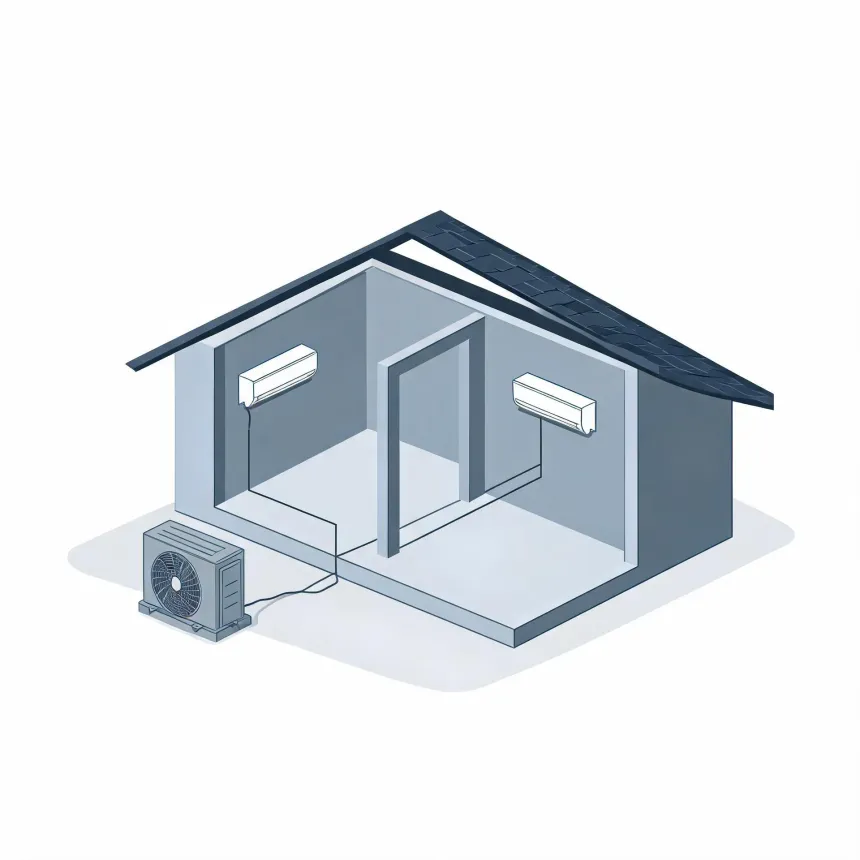
Isometric illustration of a cutaway house showing two wall-mounted indoor air conditioning units connected by lines to a single outdoor condenser unit on the ground outside.

A mini split in Kahului runs cooling every month of the year.

A system that never gets a season off needs to be sized right from the start.

Most homes here already run on electricity, and a mini split fits right in

38.7% of homes heat with electricity
Summer afternoons average 81°F
Power costs 42.86 cents a kWh statewide

Kahului falls under zone 1A, the warm, humid zone. Any mini split installed here has to meet the federal minimum for that class. For units built on or after January 2023, that means 14.3 SEER2 for cooling. The same floor applies whether the unit is ducted or ductless, since the standard treats a mini split as a split system like any other. A federal tax credit is available for systems that qualify, worth looking into when you're comparing units and quotes. Given what power costs here, there's little reason to install at the minimum when higher-SEER2 units are on the table.

Compare units on efficiency, not just price

At 42.86 cents a kilowatt-hour, the SEER2 rating on your new system is not a detail to skim past. Ask the contractor for the efficiency numbers on every unit they quote, and compare what each one costs to run, not just what it costs to install.

Find a contractor
A man in a brown jacket, cap, dark pants and work boots walks up concrete steps toward a red front door, carrying a waxed canvas tool tote with a hammer inside.
A beige split-system air conditioner outdoor condenser unit mounted on metal wall brackets atop a stucco wall.

This unit doesn't get a season off

Afternoon highs average 81°F in June, July and August, and cooling runs every month of the year here. There's no stretch where the unit sits idle and catches up on itself. When you're comparing quotes, ask what size load each contractor calculated for your house, not just what equipment they're proposing. A unit sized off a rule of thumb instead of a real load calculation will run harder than it needs to, every month it's in service.

Bigger isn't better here

An oversized mini split cools the room fast, shuts off, then starts again a few minutes later. Each of those short runs ends before the system settles into steady operation, which is when it actually pulls moisture out of the air. The room ends up cold and damp instead of just comfortable. A unit sized correctly runs longer, steadier cycles and does both jobs, temperature and humidity, the way it was designed to.

The load calculation is the real work

Sizing a mini split means working out how much heat the space gains through its walls, windows, roof and the people and appliances inside it, room by room. That number, not the square footage and not what the last unit was rated for, determines what size head goes where. A contractor who skips this step and sizes off a rule of thumb is guessing, and a system sized too big or too small from the start never runs the way it should.

Ask how many zones the quote covers and why. A mini split can run one indoor head off one outdoor unit, or several heads off a single outdoor unit, each with its own thermostat. More heads on one outdoor unit means more flexibility room to room, but it also means that unit has to be sized for the combined load, not just the biggest room. Ask what happens if you add a zone later, whether the outdoor unit has the capacity or whether it has to be replaced. Ask about the line set too, the refrigerant piping between indoor and outdoor units, since a longer run between them can affect performance and isn't always included in the base quote. And ask who services the brand locally. A unit nobody nearby is trained on can leave you waiting on a part or a tech who knows it.

Installation starts with the outdoor unit and where it sits. It needs clearance on all sides for airflow and a short run to each indoor head, since every foot of line set is a foot of refrigerant piping that has to be charged and tested. Running the line set usually means a small hole through an exterior wall, set at a slope so condensate drains out and not back into the house. Each indoor head gets mounted to a wall or ceiling, leveled, and connected to that line set before the system gets charged with refrigerant and tested under pressure. The last part of the job is commissioning. That means checking airflow at each head, confirming the thermostat talks to the right zone, and making sure the system holds its charge before anyone calls it done. None of that shows up on a spec sheet, but it decides whether the unit runs the way it was rated to.