







Why your AC compressor won't kick on in Hawaii

RepairCentral ACHawaii
Step 1 of 2

What ZIP code is the job in?

A compressor that won't start is usually one of a few things. The capacitor that gives it the jolt to start up has gone weak, so the unit hums and then quits. The contactor that feeds it power has pitted contacts and won't close. Or the compressor itself is drawing too much current and an internal overload is tripping to protect it before it can engage. Running an AC most of the year in Hawaii's heat and humidity puts real hours on these parts, more than a unit in a milder climate ever sees, and that wear adds up. Some causes are a quick swap. A failing compressor is a bigger repair, and sometimes the more sensible move is replacing the unit rather than chasing one that keeps breaking down. Either way, this isn't one to troubleshoot yourself. It needs someone who can test the right parts and tell you which one you're actually dealing with.

A gray-haired man in a dark sweater sits on a light gray sofa in a living room, looking toward a sunlit window with trees outside.
A gray-haired man in a dark blue sweater sits on a light gray sofa in a sunlit living room, looking off to the side, with a potted plant, shelving unit, and large glass doors behind him.
A bearded man with graying hair in a dark green sweater sits on a sofa in a living room, looking off to the side, with a sliding glass door and a dim kitchen doorway behind him.
A gray-haired man in a dark knit sweater sits on a light gray sofa in a living room, looking toward a sunlit window, with houseplants, a lamp, and framed art in the background.

Your AC is running but the air isn't cold

Go outside and listen. If the fan on top of the outdoor unit is spinning but you don't hear the deeper hum of the compressor underneath it, that's your answer. Sometimes you'll hear a single click or hum that cuts out after a second, which is the capacitor or contactor trying and failing. Inside, the air still moves through your vents, but it comes out warm since nothing is cooling it. Left alone through a Hawaii summer, the indoor unit can ice over from running with no cooling happening, and the humidity in your house climbs along with it. The longer it sits like this, the more the rest of the system has to work to keep up.

An outdoor air conditioner condenser unit on a concrete pad beside a house with light horizontal siding, with a small electrical disconnect box on the wall, mulch and shrubs at left, and a plain white wall and concrete slab at right.

What the capacitor actually does

The compressor needs a strong jolt of power to get its motor turning, more than the normal current can give it. The capacitor stores that charge and releases it in one burst. Heat wears it down, and your compressor works against Hawaii's heat and humidity for months without a break most years. When the capacitor weakens, the compressor tries to start, pulls hard, and trips back off. That's the hum you hear before it quits.

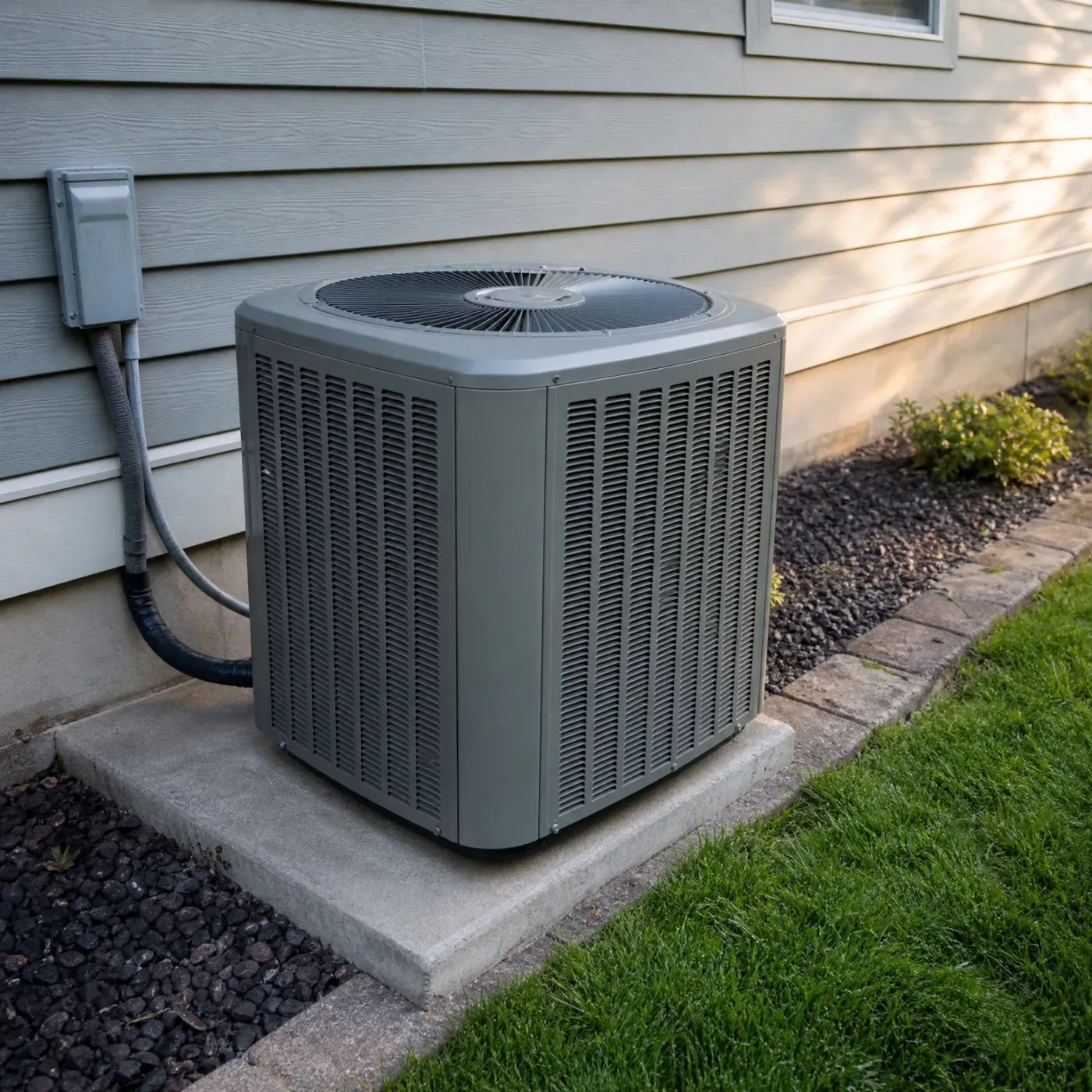
A dark gray outdoor air conditioner condenser unit on a concrete pad beside a house with horizontal siding and a plain light wall, with mulch and grass in the foreground and a conduit and electrical box on the wall.

Why the contactor fails quietly

The contactor is a switch, and every time your AC cycles on, it closes to send power to the compressor. Over thousands of cycles the contacts pit and burn, and eventually one won't close all the way. No hum, no click, nothing. Power just doesn't reach the compressor. Homes running their AC daily through a Hawaii summer put more cycles on that switch in a year than a system elsewhere might see in two.

What happens if the contactor is the problem instead?

The capacitor explanation above covers one cause, but you might have already checked for that click or hum and heard something different, or a contractor mentioned the contactor as another likely part. You want to know what that one does and how it fails, since it changes what's actually wrong with your unit.

A stuck or pitted contactor won't send power to the compressor at all

The contactor is the switch that closes when your thermostat calls for cooling, sending power from the breaker down to the compressor and the outdoor fan. Every time it closes, a small arc jumps across the contacts. Over thousands of cycles, that arc pits and burns the metal until the contacts don't close all the way, or don't close at all. When that happens, nothing reaches the compressor. You might hear the outdoor fan running on its own circuit, or hear nothing outside at all. Ants and other debris getting into the contactor housing cause the same failure, which is common in an outdoor unit that runs as many months a year as yours does.

A middle-aged woman with shoulder-length dark hair, wearing a gray cardigan over a cream top, sits in an upholstered armchair and looks toward a sunlit window, with a shelf holding framed pictures and a plant behind her.
A woman and a child wrapped together in a knitted gray blanket on a couch, with the child's head resting on her shoulder and a lit table lamp and houseplant in the background.

Matched to your air conditioner job

A compressor that won't start on a muggy July afternoon isn't something to leave for next week. Once the heat and humidity set in, a house without working AC gets uncomfortable fast, and a capacitor or contactor that's already failing tends to get worse, not better, the longer it sits. Power costs enough here that you don't want a unit running partway, drawing current and doing nothing, either. A contractor who works on compressors all summer in this climate has likely seen your exact symptom before and knows which part tends to go first in units like yours. Getting matched with one local contractor means the person who calls you back is already thinking about your equipment, not working from a form. You deal with the heat enough in a normal week. No reason to sit in it waiting on a part that a local tech already knows how to track down.

Calling someone yourself

You can search around and call a few AC repair companies on your own. Some will pick up, some won't, and you may end up leaving messages and waiting on callbacks while your house sits warm. You're the one checking if they're licensed, asking what they charge for a service call, and figuring out who actually works on compressors versus who mostly does installs. It can work out, but it takes your time, and in Hawaii, where parts and techs aren't always sitting on every corner, you might call three places before one has an opening this week.


Getting matched with one contractor

Instead of calling around, you submit your situation once and a licensed contractor local to your area reaches out to you directly. It's one contractor, not a handful of companies competing for your callback, so your phone isn't blowing up with sales pitches. The contractor matched to you works on this equipment through every muggy season here and has a sense of what usually gives out first in a compressor, the capacitor, the contactor, or the motor windings. You still decide what happens once they call.

An outdoor air conditioner condenser unit sits on a concrete pad beside a stucco wall, with refrigerant lines and conduit running to the wall and a shrub to the left.
Before you get your air conditioner repair
A gray outdoor air conditioner condenser unit on a concrete pad beside a house with dark horizontal siding and a stone base, surrounded by gravel, with a flowering shrub at left and a concrete walkway in front.
After you get your air conditioner repair
  1. Thermostat calls for cooling and sends power to the contactor coil.

  2. Contactor closes and sends power to the compressor and capacitor.

  3. Capacitor releases its stored charge to start the compressor motor.

  4. Compressor turns and starts pulling in refrigerant gas.

Power costs 40.40 cents per kilowatt-hour statewide

At 40.40 cents a kilowatt-hour, a compressor that keeps trying and failing to start is costing you every time it does it. A weak capacitor often makes the unit attempt to start over and over, and each attempt draws power whether the compressor catches or not.

EIA-861 2025 statewide residential average

What a dead compressor comes down to

  • A compressor that won't start usually comes down to a weak capacitor, a bad contactor, or the compressor motor itself.
  • Checking which one it is means testing parts with a meter, not guessing from what you hear outside.
  • A unit that hums and quits or trips the breaker on repeat attempts is drawing power without doing the job it should.
  • A technician who works on compressors all over Hawaii every summer has likely already seen whatever is wrong with yours.
  • Getting matched with one licensed local contractor means one visit, one diagnosis, and no juggling calls from several companies.
  • Once you know which part failed, the fix is straightforward for someone who works on this equipment regularly.

A compressor that stays silent almost always traces back to one of three parts: the capacitor, the contactor, or the compressor motor itself. The hum and quit, the single click, the breaker that trips on the second or third attempt, all of it points somewhere specific once someone puts a meter on the unit instead of guessing from the sounds it makes. That's the part of this a homeowner usually can't finish alone. You can listen at the outdoor unit and get a good guess, but confirming it means pulling the panel and testing.

What happens next matters as much as the diagnosis. Hawaii doesn't have many AC contractors working through a mild winter the way other states do. Compressors here run hard for months at a stretch, and the people who service them see the same failures summer after summer, which means whoever shows up at your house has likely already run into whatever's wrong with yours this season. Getting matched with one licensed local contractor, rather than a handful of companies competing for the callback, means a single visit handles the diagnosis and the fix without you fielding calls from three different outfits trying to beat each other to your door.

Once the failed part is identified, the repair itself is routine work for someone who does this regularly. A capacitor or contactor swap is quick. A compressor motor is a bigger job, but it's still a known fix, not a mystery, once someone qualified has had a look.

A gray outdoor air conditioning condenser unit on a concrete pad beside a house with horizontal lap siding, with a wall-mounted disconnect box and conduit, lava rock mulch, a shrub, and grass nearby.

An air conditioner pro near you

Get my match

Only one pro gets your request, so you hear from one company.

There's no charge for the request.